The Oversight Gap: Why Property Owners Need Visibility Their Property Manager's Software Can't Provide
Hiring a property management company gains you leverage and costs you visibility. Here is why the property management oversight gap exists, and what closes it.
It's March, and your CPA just emailed you. She needs to know whether the $6,200 plumbing charge at your duplex was a repair or a capital improvement. You know the answer is somewhere in your inbox. Your property manager sent you the original scope, the revised quote, your approval, and the final invoice. But that was eight months ago, across six or seven emails, mixed in with hundreds of other messages from three other properties.
You open Gmail and start searching. Forty-five minutes later, you've reconstructed the story. One property down, three to go.
This is the Oversight Gap. And if you own rental properties managed by a third-party property management company, you've almost certainly felt it, even if you've never had a name for it.
Two worlds of property ownership
The property management software market, worth over $3.6 billion in 2025 and growing at 6.4% annually, is built for the people who operate properties: property management companies running day-to-day operations, and self-managing landlords who handle everything themselves. Platforms like AppFolio and Buildium power property management companies; tools like Stessa and TenantCloud help DIY landlords collect rent, coordinate maintenance, and handle accounting. These are tools to do the work.
But there's a second type of owner. You bought rental properties as investments. You hired a property management company to handle operations so you wouldn't have to. You're not collecting rent or fielding maintenance calls. Your property manager handles all of that.
You don't need tools to do the work. You need tools to know what's happening.
The entire software industry serves operators. Almost nothing serves the second owner. And as single-family rental investment continues to grow, with investors now owning roughly 20% of the 86 million single-family homes in the US, that second owner population is large and expanding.
What the Oversight Gap actually is
The Oversight Gap is the structural loss of visibility that occurs when a property owner delegates operations to a third-party property management firm. It is the reason property management oversight is hard to do well even when everyone involved is competent and honest. It's not about trust, and it's not about bad property managers. It's a principal-agent problem that exists in every delegation relationship.
When you managed your own properties, you had ambient awareness. You knew a repair was happening because you scheduled it. You knew what it cost because you paid the vendor directly. You knew the timeline because you were coordinating it.
The moment you hire a property manager, that ambient awareness disappears. You now learn about events through email updates. Those updates are often fragmented: a maintenance request in one email, a vendor assignment in another, an approval request a week later, a completion notice the week after that. Each email makes sense when you read it, but nobody is assembling them into a coherent picture of what's happening across your portfolio.
The gap is structural, not personal
A property manager can be excellent at their job and you can still have an Oversight Gap. The gap doesn't come from your property manager withholding information. It comes from the fact that operational knowledge arrives as a stream of individual emails, and no one is turning that stream into structured intelligence for the owner.
This matters because the decisions that protect your investment, whether to approve a major repair, when to replace versus patch, whether your property manager is performing well, whether to sell a property or hold it, all require context that spans months of communication across multiple properties.
Why your current property oversight tools don't solve it
If you've felt this gap, you've probably tried to close it. Most owners cycle through the same four approaches before giving up.
Your property manager's portal
Your property management company uses software like AppFolio, Buildium, or Rent Manager. Some of these platforms offer an owner portal with limited access. But these portals are designed for the property manager's workflow, not the owner's needs. You might see a list of work orders or an owner statement, but you won't see the email thread where the scope changed, the conversation about why a particular vendor was chosen, or the timeline of how an issue evolved. The portal shows you transactions. It doesn't show you the story behind them.
As we detail in our deep dive into the property management software ecosystem, these platforms are investing heavily in AI-powered automation for property managers: automated maintenance triage, AI leasing agents, predictive maintenance scheduling. None of that intelligence flows to the owner.
Owner statements
Your monthly or quarterly owner statement is a financial summary. It tells you what was spent. It doesn't tell you why. When your CPA asks whether that $4,800 charge was a repair or a capital improvement, the owner statement just says "Plumbing - Unit 3B: $4,800." The context, the original scope description, the change order, the approval chain, lives in your email. We wrote about this specific problem in detail: your owner statement has the numbers, but your email has the story.
Spreadsheets and Gmail labels
This is the DIY approach. You create a spreadsheet to track maintenance events, or you set up Gmail labels for each property. It works for about two months. Then a busy week happens, you fall behind on logging, and the spreadsheet goes stale. Gmail labels help you filter, but they don't connect related emails into cases or surface patterns across properties.
The fundamental problem with manual tracking is that your property management communication generates dozens of emails per property per month. Across a portfolio of five to ten properties, that's hundreds of emails. No manual system scales to that volume without becoming a part-time job.
Financial tracking tools
Platforms like Stessa and Baselane are built for rental property owners, and they're genuinely useful for tracking income, expenses, and financial performance. But they track what was spent, not what happened. They can tell you that maintenance at a particular property cost $8,400 last year. They can't tell you that four of those charges were for the same HVAC system that probably needs replacement instead of another repair. That pattern is only visible when you can see the operational narrative, not just the financial summary.
A multibillion-dollar industry that doesn't build for you
Property management is a low-margin, labor-intensive business, and the software industry has responded with an enormous ecosystem of tools to help. Enterprise platforms like Yardi and RealPage power the largest operators. Mid-market tools like AppFolio and Buildium help growing property management companies manage thousands of units. DIY platforms like Stessa and TenantCloud help self-managing landlords handle rent collection, maintenance, and accounting.
All of this software serves people who operate properties. None of it serves the owner who hired someone else to operate them.
Your property manager has a system to track work orders, vendor assignments, lease renewals, and financials. You have your inbox. There is no category of software designed to give a property owner structured visibility into the operations they're paying someone else to handle. The Oversight Gap isn't a feature that's missing from existing tools. It's an entire problem that the industry has never addressed.
The owner's system of record is email
Here's the thing that makes this problem solvable: despite all the software property managers use internally, the owner's primary channel for operational information is still email.
Every maintenance request, vendor invoice, lease renewal, tenant complaint, approval request, and status update flows through email. Your property manager might use AppFolio or Buildium internally, but they communicate with you via Gmail or Outlook. This has been true for years, and it's likely to remain true even as property management software evolves, because email is the universal interface between organizations.
The problem isn't that the information doesn't exist. It's that email is unstructured. A single maintenance event might span 8 to 15 emails over three weeks. A turnover might generate 20 to 30 emails involving multiple vendors, inspections, and approvals. For one property, you can follow along. For a portfolio of five, ten, or fifteen properties, each generating dozens of emails per month, it becomes impossible to maintain a coherent picture of what's happening.
This is why the Oversight Gap feels like a time problem ("I don't have time to read all these emails") when it's actually a structure problem. The information is there. It's just arriving in a format that doesn't scale.
What closing the gap actually requires
The answer isn't more dashboards in your property manager's portal or another spreadsheet template. It's turning the unstructured stream of email communication into structured portfolio intelligence: cases you can review, patterns you can spot, and timelines you can reference when you need context. And it has to work with whatever your property manager already uses, requiring nothing from them.
What portfolio intelligence looks like
If you could close the Oversight Gap, what would change?
Instead of searching Gmail for forty-five minutes to reconstruct a maintenance event for your CPA, you'd open a case that shows the full timeline: initial request, vendor assignment, scope change, approval, completion, invoice. All connected, all in sequence.
Instead of wondering whether your property manager is on top of a developing issue, you'd see your open cases across the portfolio, know how long each has been active, and spot the ones that need attention.
Instead of reviewing your owner statement line by line and trying to remember what each charge was for, you'd have the operational context linked to every expense. The metrics that actually predict your rental ROI, like maintenance velocity, vendor cost consistency, and recurring issue patterns, would be visible without manual tracking.
Instead of preparing for a property manager review or transition with nothing but a vague sense of "things seem okay," you'd have a structured record of every operational event, how it was handled, and how long it took.
This is what we've built with The Control Surface. It connects to your Gmail (read-only), scans your property management emails, uses AI to extract structured data, and clusters related emails into cases. One case per maintenance event, per lease renewal, per turnover, per vendor interaction. It requires nothing from your property manager because it works with the emails they're already sending you.
Here is a real example from our case study: 28 emails across 8 vendors over 10 weeks, organized into a single case with cost breakdowns by topic.
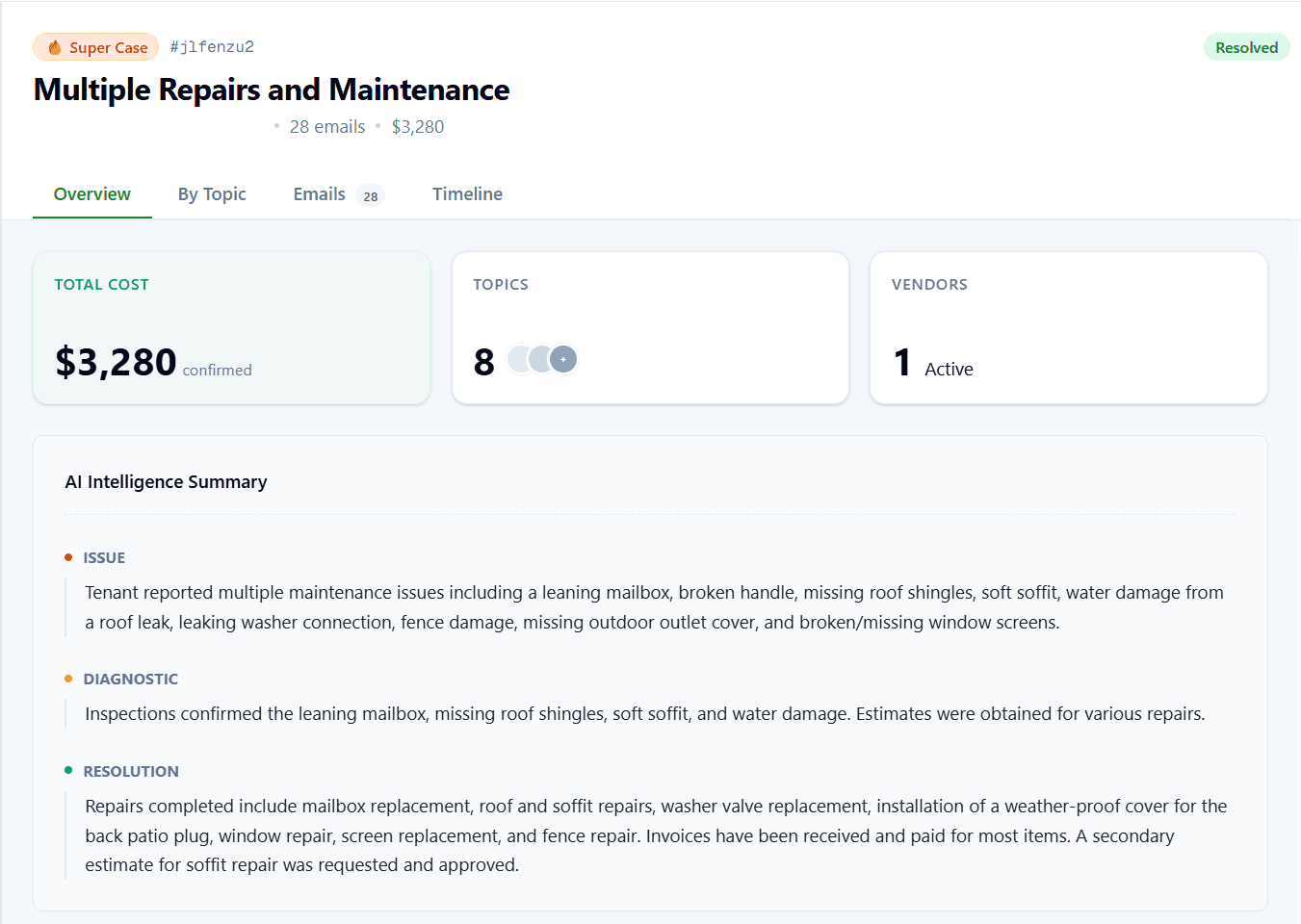
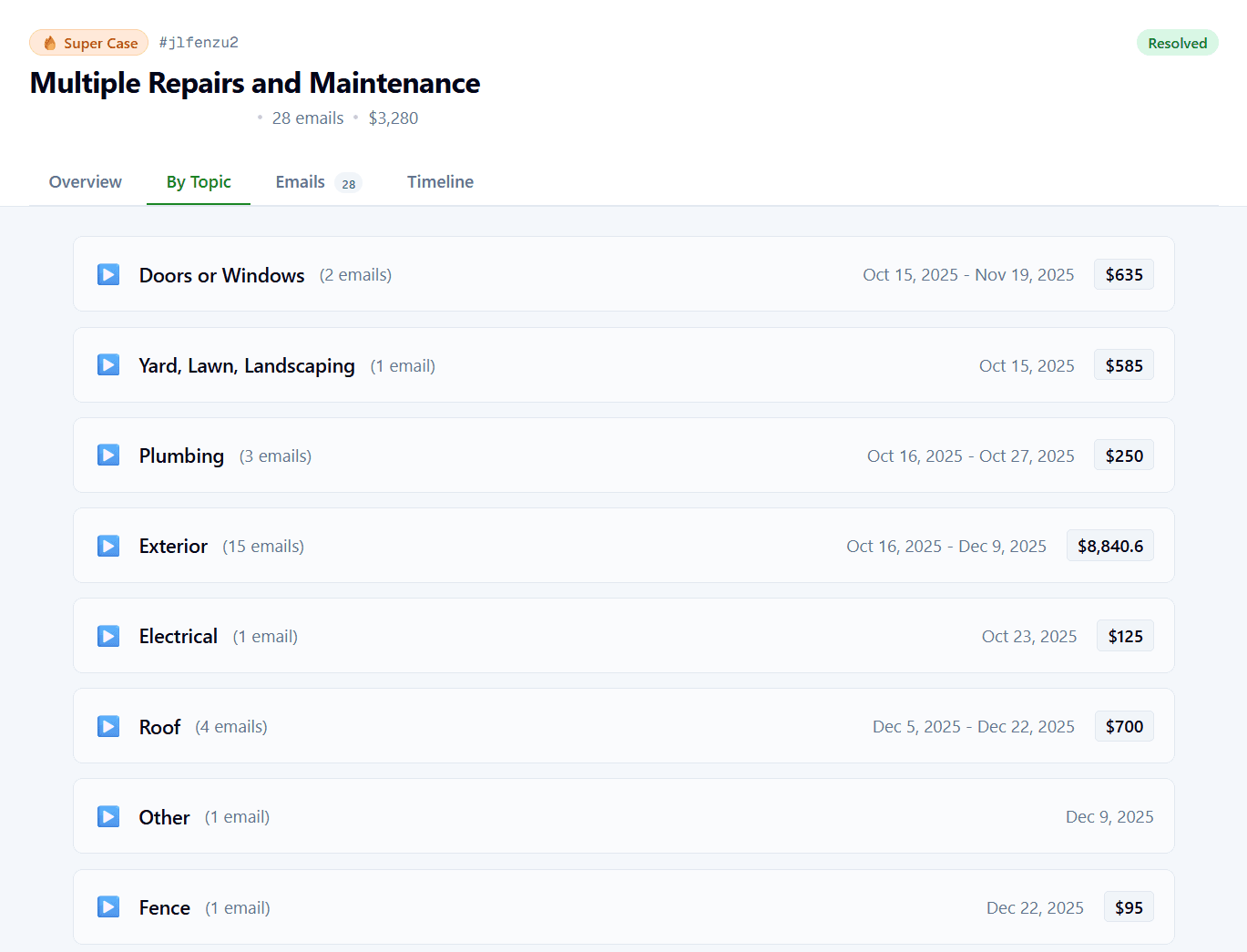
The multiple repairs case. 28 emails across 8 topics in 10 weeks, each with its own estimate and invoice cycle.
You can track your portfolio across the operational metrics that matter, see the full story behind every line item on your owner statement, and maintain the kind of visibility you had when you managed your own properties, without going back to managing them yourself.
Your first property is free, permanently. You can see what's in your email in about six minutes.