What 14 Months of Property Management Emails Actually Contained
A real portfolio audit. 12 properties, 125 cases, $99,728 in costs, organized from the emails I was already getting.
Emails Scanned
1,196
14 months
Cases Organized
125
Distinct issues or projects
Total Costs
$99,728
Across 12 properties
Vendors
20+
Plumbers, roofers, etc.
I own 12 single-family rentals in the Dallas-Fort Worth metro. We use a property management company so we can be hands-off. But somewhere around property six or seven, the emails started blending together. A sewer line breaks at one property. A few weeks later, a similar plumbing issue shows up at another. "Sewer line," "tree root," "camera inspection," "leak." The same keywords showing up from two different addresses. Did I already approve that quote? Was that this property or the other one? Is this the same plumber we used last time?
We have been investing together with a group of co-investing friends since 2010. We all have day jobs; managing the properties was never supposed to be a big part of our work week. Passive income is the goal, but we still want to be informed, so our property manager sends us email and approval updates.
It would all be easy if each property was one email thread so I could scroll down to see the history about why I am getting this invoice. Our property manager starts a discussion, but when they get a vendor quote two weeks later, they forward it as a new thread. The context from our earlier discussion is not in the thread any more. Now either I am trying to remember, or searching Gmail, and once this happened frequently enough, the hassle-factor caught my attention.
I decided to organize every property management email I had received from the last 14 months (and counting) automatically. Here is what they contained.
What 1,196 Emails Looked Like When Organized Into Cases
When I say "125 cases," I mean 125 distinct issues that impacted one of my properties, each one a group of related emails organized into a timeline. A slab leak that generated 57 emails over six months, encompassing camera inspections, plumbers, drywall and painting, and landscapers becomes one case instead of a dozen separate threads. Here is a comparison between an inbox of emails and what it looks like organized as a case:
A case is a group of related emails about one issue at one property, organized into a single timeline with vendors, costs, and decisions connected together. Instead of a dozen separate threads, I get one story.
In my inbox
Water issue reported at property
Property Manager · Jul 22
Re: Estimate for main line replacement
Plumbing Co. · Aug 14
Two quotes for flooring replacement
Flooring Vendor · Aug 14
Fwd: Sheetrock repair estimate - 13 holes
Property Manager · Aug 14
Claim #4821 - Water damage inspection
Insurance Adjuster · Aug 28
Fwd: Sewer line camera test results
Property Manager · Sep 4
Schedule for mold remediation work
Drywall Contractor · Oct 3
In The Control Surface
Cost
$40,063
Emails
57
Vendors
5
Issue
A major slab/plumbing leak was reported, causing mold and damage. A non-functional garbage disposal and leaking exterior faucet were also reported.
Diagnostic
Slab leak requiring main water line and interior water line replacement. Camera test detected root intrusion and backfall on sewer lines.
Resolution
Water lines replaced. Sewer line repaired and approved by the City. LVP flooring and tile installed. Sheetrock repairs completed. Insurance claim initiated.
The volume was not evenly distributed across properties. Some properties were quiet, while others generated over 200 emails in 14 months.
Email Volume by Property
Total emails per property over 14 months, sorted highest to lowest
Email Breakdown by Category
1,196 emails across 7 categories. Maintenance alone was 39%.
The Cost Picture
The total documented costs across all 12 properties over 14 months came to $99,728. Seeing it all added up was useful, but what was more interesting was how unevenly distributed the spending was. Two properties consumed 62% of all costs:
Property A: $40,063. A slab leak that became a full restoration project. Over six months, the scope expanded to include main water line replacement, all interior water lines, sewer line replacement, mold remediation, drywall, flooring, yard leveling and sod, and a garbage disposal electrical issue. Two separate insurance claims were filed. Fifty-seven emails from five different vendors.
Property B: $21,569. A plumbing and HVAC cascade that started with a routine kitchen leak. It turned out to be a rotted copper drain line. Over seven and a half months, 4 different vendors came through for sheetrock repair, pipe reinstallation, cabinet board replacement and resealing. While they were fixing the plumbing, the HVAC system failed too. Eighteen emails across four vendors.
The other 10 properties combined: $37,959. This large variation in annual repairs is not unusual. It is actually a feature of real estate investing and why having a portfolio of properties is better than having just 1 or 2. When a big system needs replacing, it costs what it costs, and having 8 cash flowing properties to fund the repairs for the one that needs a big repair this year allows us to continue to invest over time. This year's expensive home will be next year's cash flow to fund whatever may happen in the future.
Cost by Property
Annual costs by property. Two properties consumed 62% of total spend.
Operating Expenses by Month
Total monthly maintenance costs across 12 properties, Jan 2025 - Feb 2026
This is why trailing 12-month views matter more than monthly snapshots. And it is why the quarterly portfolio review uses rolling numbers rather than month-over-month comparisons.
Unlock the Full Case Study
Enter your email to unlock:
- Three real cases from Nick's portfolio, with costs, timelines, and what he learned
- The four changes he made to how the portfolio is managed, and why
Nick personally reviews every submission. No automated sequences.
Three Real Cases from My Account
These are cases from my own portfolio in The Control Surface, with real screenshots, though I edited out property addresses and names.
Case 1: The Slab Leak, $40,063
Property A | 57 emails | Jul 22, 2025 - Feb 4, 2026 | 6 months
July 2025. Tenant reports a water leak in the bedroom and a leaking exterior faucet. What followed: main water line replacement, all interior water lines replaced, sewer line replacement, mold remediation, drywall, flooring, yard leveling and sod, garbage disposal electrical repair. Insurance claims initiated for both water damage and sewer, two separate claims on one event.
In Gmail, this appears as 57 emails in separate threads from five different senders.
The lesson: For a $40K repair, being able to reconstruct the full timeline from the beginning helps decision making and reduces stress. It gives you the context to verify the costs, confirm insurance covered what it should have, and understand what decisions were made and when. The Control Surface scans your inbox daily, automatically, so cases assemble email by email.
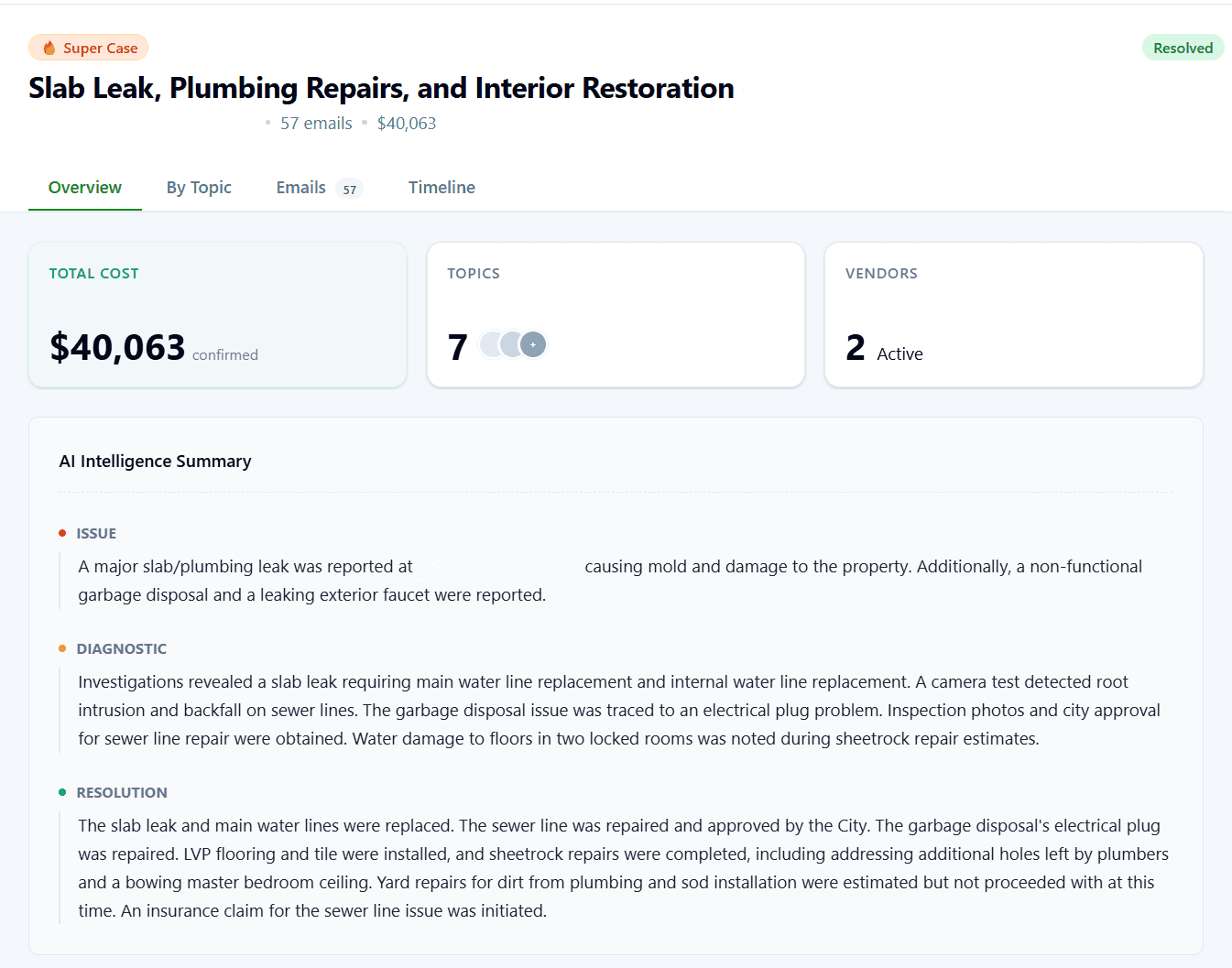
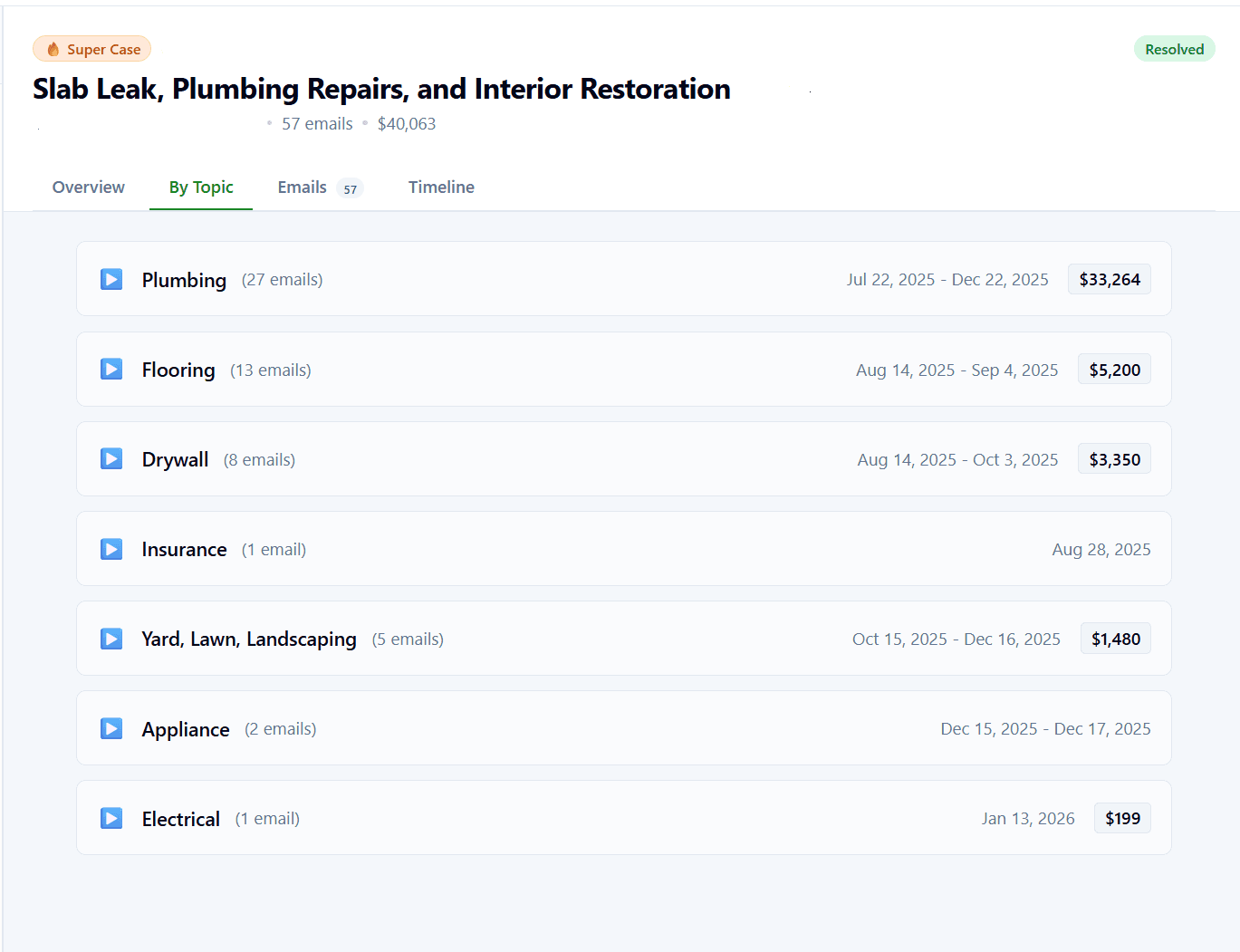
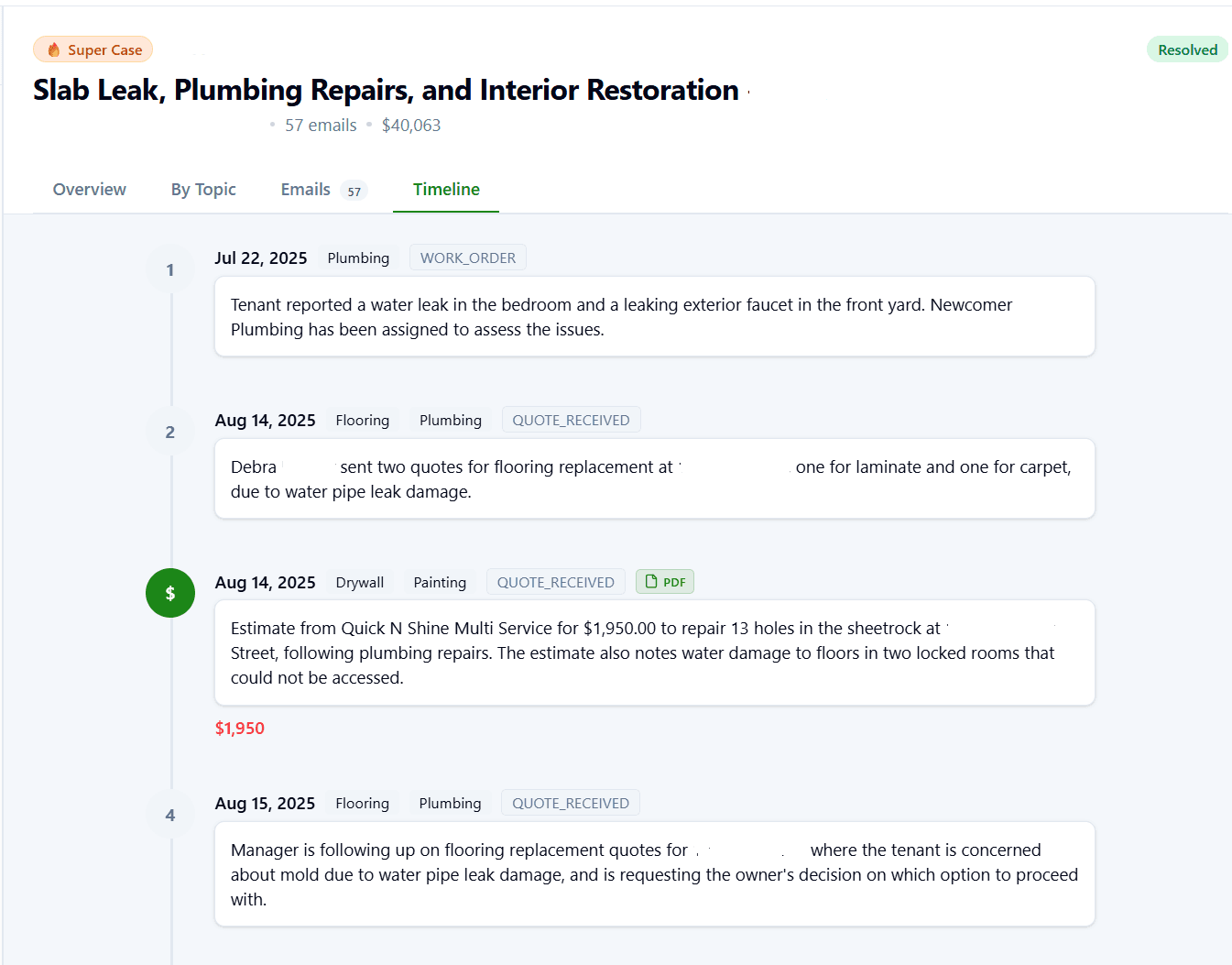
The slab leak case as it appears in The Control Surface. 57 emails from 5 vendors over 6 months, organized into one case.
Case 2: 28 Emails, 8 Vendors, $3,280
Property G | 28 emails | Oct 15 - Dec 22, 2025 | 10 weeks | 8 vendors
A new tenant moved in and immediately reported what seemed like a short punch list: a leaning mailbox, a broken handle, some missing roof shingles. Then the scope expanded. Soft soffit. Water damage from a roof leak. A leaking washer connection. Fence damage. A missing outdoor outlet cover. Broken window screens.
Over the next ten weeks, eight different vendors cycled through: a locksmith, a plumber, a glazier, a roofer, a general contractor, a landscaper, a handyman, and a property maintenance crew. Twenty-eight emails coordinating scope, estimates, approvals, scheduling, and invoices. No single repair was above roughly $800. Total: $3,280.
This was also the same property that had just gone through a full turnover. The tenant vacated in August. We marketed it, screened applicants, approved a lease with a pet deposit, executed the lease, and completed a make-ready, all before October. By the time these repairs started, we were already 55 emails deep on this one property for the year. This was the eighth separate case at this address in 14 months.
The lesson: Not every high-cost property has one big event. Some accumulate cost through volume: eight vendors, each with their own estimate-approve-schedule-invoice cycle, all running in parallel. You only see the pattern when you can see all the cases for one property together.
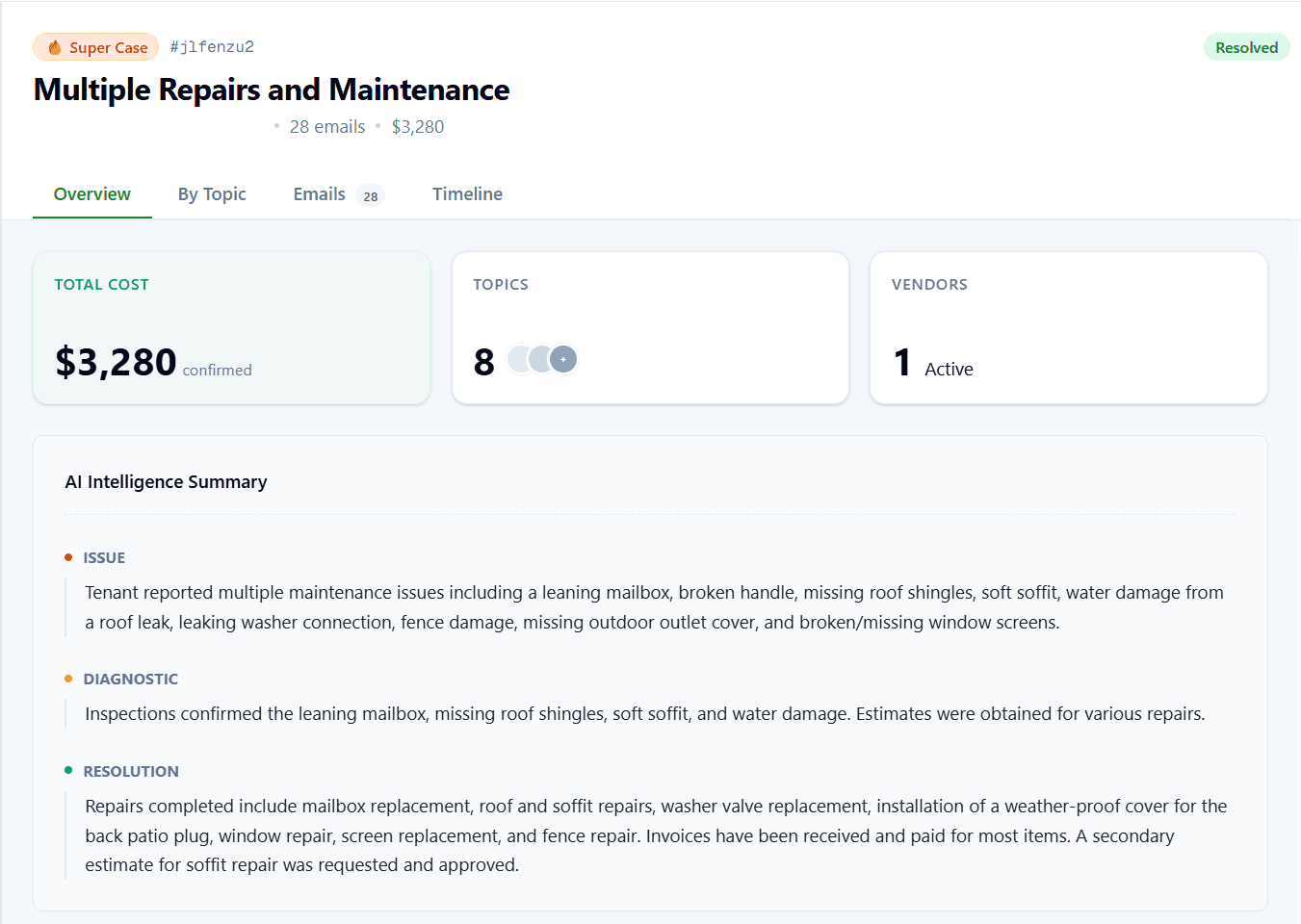
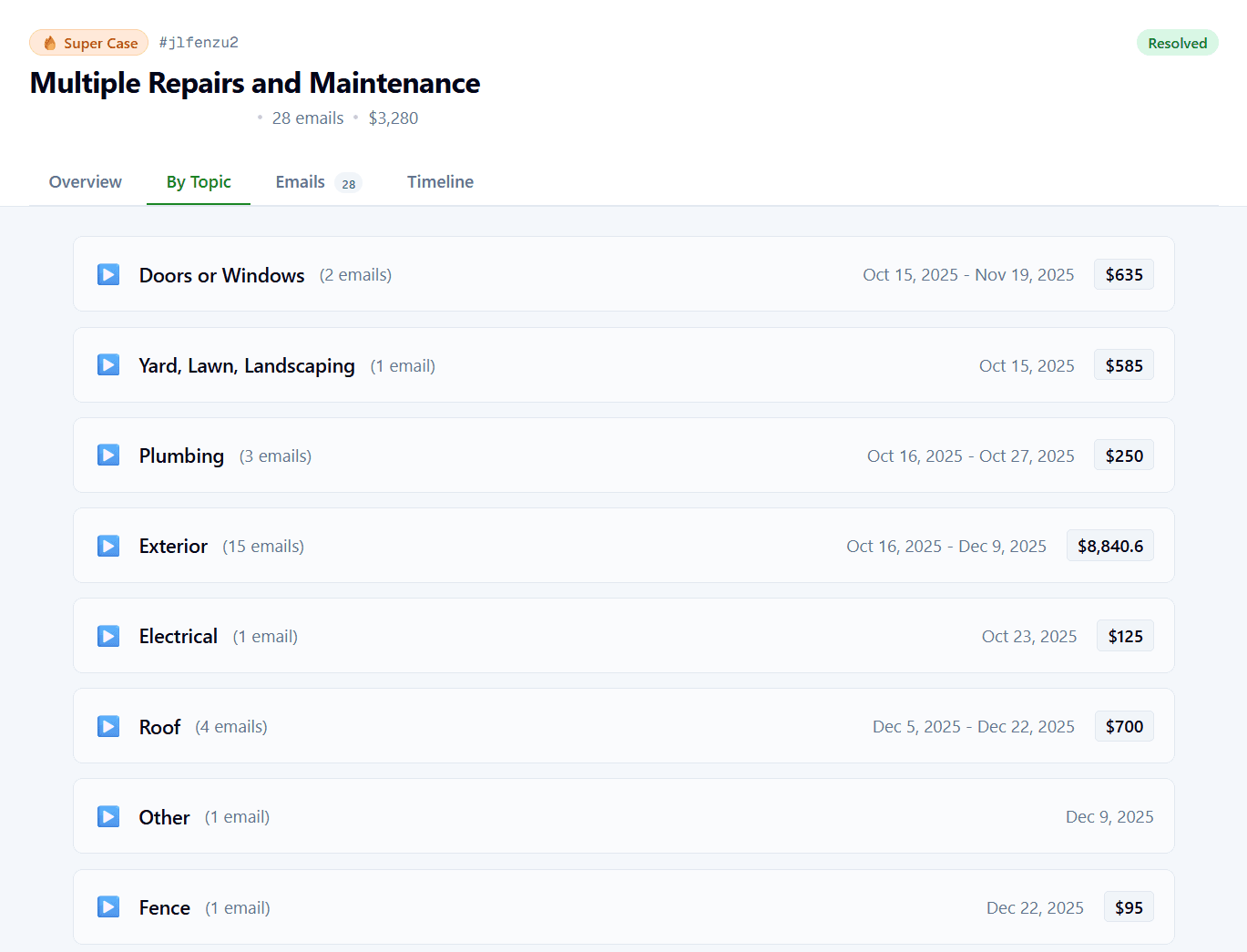
The multiple repairs case. 28 emails across 8 topics in 10 weeks, each with its own estimate and invoice cycle.
Case 3: The Sewer Line Done Right, $4,525
Property F | 9 emails | Nov 7 - Dec 22, 2025 | 6 weeks | 2 vendors
November 7, 2025. Tenant reports strange toilet sounds and plumbing overflow outside. The first vendor cleared the immediate stoppage and diagnosed a structural "belly" in the sewer line; it needed full replacement, not just a clearing.
We requested a second estimate. Vendor two came in at $4,025 for the replacement. We approved it. The work was completed and a camera test confirmed the fix. Final invoice: $4,275. Total with the initial clearing: $4,525.
Nine emails. Two vendors. Six weeks start to finish.
Compare this to Property A, which had a similar plumbing issue that stretched over six months and involved five vendors. The difference this time was not the problem; sewer lines break. The difference was that we took our lessons learned and were more proactive. When we saw a toilet issue, instead of having the plumber clear a clog and leave for $150, we got a real plumbing test right away, discovered the structural issue, and immediately addressed it. The result was a lower cost, in part because we were a better customer to deal with for the vendor.
The lesson: Fast decisions enabled by the right context turned a major repair into a six-week resolved case. The same type of issue at a different property took six months. Speed comes from having the right information and acting on it.
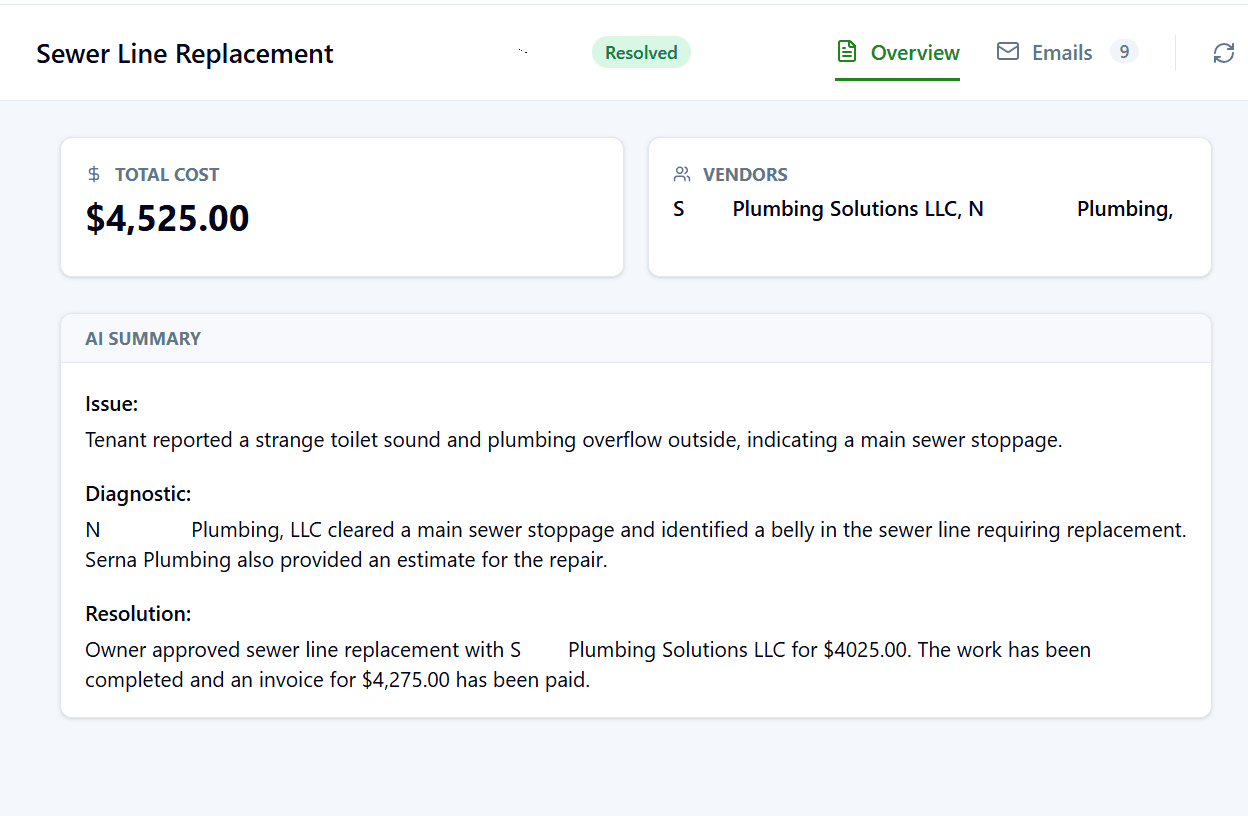
Nine emails, two vendors, six weeks. A $4,500 sewer line replacement handled cleanly.
Portfolio-Level Patterns
Beyond the individual cases, organizing the emails surfaced patterns that will help us manage the portfolio better in the future.
Property tax protests across all 12 properties
We protest our property taxes on every property every year, because property taxes cost at least 20% of annual rent, but can be as high as 30% or more. It is a lot of work each year and stretches from April through August. Now we have an easily reviewed record of where we succeed each year (less than half the time) and what we tried so we can get better next time.
Insurance renewal: 8% increase year-over-year
Like property taxes, insurance on our properties is a large recurring expense that generates its own operational overhead and does not come from our property manager at all. We need to keep track of which insurer covers which properties, what the rates are, claim statuses, and stay on top of renewals. This is a growing area of effort as insurance rates climb, so now we are looking at how we manage our policies and exploring options. Cases help us stay organized.
Portfolio Policies
The Portfolio Management section of The Control Surface also assembled our financial statements so it was easy to find the latest reports. This year we also revisited our pet policy so now I have a case that documents the decision we made there. We are also looking at what expenses we can auto-approve to speed up decision making further and assessing the impact there.
How I'm Using These Insights To Improve Our Rental Portfolio Performance
Before I organized these emails, I had a vague sense that all was not perfect with our portfolio, but I could not get specific about where the problems were. Now I have what I need to start making changes so 2026 and 2027 can be better than 2025 was.
Here are the problems I see in this data and what we plan to do about them:
-
Lease end dates and vacancy. We have a few properties whose leases terminated in November, creating vacancy when we could not find a tenant during the holiday season. We need to adjust our lease terms when the next tenant signs to move to more favorable end dates.
-
High property tax burden at one property. We need to look at the property with the highest property tax as a percentage of rents to see what we can do to improve the rents at that unit. I know it is in a desirable area, so perhaps there is a modest investment we can make to justify higher rents.
-
Turnover management. We had some big projects during tenant turnovers, and when the repairs take a long time, the costs and revenue loss accumulate. By being more aware of those timelines, I can stay on top of which properties need attention and keep my property manager focused. This includes being more timely on responses to requests for approval and exploring approaches to complete more things in parallel to shorten timelines.
-
Tenant retention. Now that the cost of tenant turnover is clear, I am going to review each tenant history, how long they have been in the property, and see what we can do to retain our good tenants for longer.
With this data organized, I have what I need to start doing a more rigorous quarterly analysis on our portfolio and find opportunities to make better decisions.
See What Is In Your Inbox
The information was in my inbox the whole time. I just did not have a way to see what it added up to until I organized it.
If you manage more than a few properties and your inbox is the primary channel between you and your property manager, there are probably patterns in your email worth seeing. Costs that concentrate on one or two properties, turnovers that cost more than you expected, approvals that need a response.
The Control Surface is what I built to solve this for myself. It connects to your Gmail, reads your property management emails, and organizes them into cases automatically. Every case referenced in this post came directly from my own inbox.
Try it on one property
One property scan is free. No credit card. No commitment. If you manage 3 or more rental properties and want to see what your email data looks like organized, start with one.
The Control Surface uses read-only Gmail access to organize your property management emails. Only email metadata, subjects, and body content are processed. No emails are modified, moved, or deleted. Scanning is powered by Gemini AI.
Nick DiCarlo is the creator of The Control Surface, to solve his own residential real estate portfolio challenges. Property addresses and vendor names have been anonymized. All numbers (email counts, case counts, dollar amounts) are from actual production data.